Author: ranco

ESMQ: Call for Papers 2016 Special Issue (16.1)

Sport management is essentially a knowledge-driven business, which relies heavily on the ability of managers to effectively acquire and interpret information, and to create and manage new knowledge. Despite the fundamental importance of knowledge to management, the academic sport management community has failed to systematically address how sport managers deal with creativity, innovations, information and knowledge management. Most work in this area has been very sporadic (i.e. not the result of a coherent programme of research) and approached knowledge creation and management from a variety of perspectives including: sociology (e.g. knowledge as power), policy (e.g. evidence-based policy making), business (e.g. using knowledge for competitive advantage) and philosophy (e.g. ontology of knowledge).

In the context of the present special issue knowledge is interpreted both as a means (i.e. routine-procedural knowledge that is concrete and manual) and as a goal (i.e. declarative-generative knowledge that is abstract and intellectual). It is generally believed that the apex of generative-declarative knowledge is creative knowledge in the sense of knowledge creation (Kaufman and Runco, 2009). However, knowledge is not an enduring object with constant properties, but rather something that is constantly recreated in a particular context. Therefore, it has to do with understanding – ‘to understand is to create’ (Piaget, 1976). The main generative mechanism for new knowledge creation in sport management comes from the exercise of judgement – the ability of researchers and managers to draw new distinctions concerning an issue at hand within the context of a dialogical relationship with particular group, community or society (Tsoukas, 2009).

Aims of Special Issue

The main goal of this special issue is to expand our understanding of the role of creativity, innovation, information and knowledge management in a variety of sport management contexts, such as sport governance, sport participation, sport events, information technology management and the learning capacity of sports organizations. This will be achieved by bringing together a collection of original, theoretically and empirically informed knowledge perspectives from various sport organisations and fields of operations. The special issue will also seek to examine critical ontological questions concerning how does the possibility emerge for the academic community to take an interest in specific sport management matters? How do research objects enter and exit the sport management gaze? Which topics and issues have emerged as result of the research activities of sport management scholars? Which sport management phenomena have themselves changed over the course of being studied?

The special issue will also serve as a useful teaching aid and reference source.

Examples of themes/sub-themes and potential authors:

The special issue will encourage submissions related to the processes of managing creativity, innovation, information and knowledge in a variety of contexts. Indicative topics include, but are not limited to:

1. How do managers and staff in sport and event organizations create, use and transfer knowledge?

2. Use and misuse of technology (social media, Internet) for information distribution and  knowledge creation;

3. Managing information and knowledge systems in sport;

4. Theoretical perspectives in knowledge creation and management taking into account the specificity of the sports management field;

5. Research approaches and techniques in information and knowledge management;

6. Evidence-based policy: the role of knowledge and its management;

7. Epistemic communities in sport management;

8. Teaching innovation and knowledge management in sport;

9. The role of organisational structure and culture of sport governing bodies in the creation of knowledge;

10. The role of knowledge management consultants in sport and event business.

How to Submit

Submission of manuscripts is open to everyone interested in the topic. Papers should be submitted in electronic format through Manuscript Central; indicating you want the manuscript to be considered for Special Issue 16.1 [manuscripts in review process].

Guest Editors

Vassil Girginov, Brunel University vassil.girginov@brunel.ac.uk
Annick Willem, Ghent University annick.willem@ugent.be
Kristine Toohey, Griffith University k.toohey@griffith.edu.au

Join the PhD Seminar at EASM 2014

For the second time, and this year in collaboration with Coventry Business School, EASM is organizing a PhD. Student seminar prior to the annual conference. Deadline for applications is Monday the 5th of May. Please forward the message to your relevant doctoral students or friends. Besides good academic discussions and brilliant key note speakers the seminar also offers opportunity for network creation and mutual inspiration for scholars in the early stage of their career. For more information, visit http://www.easm2014.com/phd-student-seminar/general-information.html

Call for participants for the PhD Seminar prior to EASM 2014

Just as in previous years, EASM will organize a PhD student seminar during the pre-conference of EASM 2014 in Conventry. 
The seminar will take place on Monday 8 and Tuesday 9 September prior to the EASM conference and is organized in 
collaboration with the Coventry Business School. The aims of the seminar are to create networks, initiate academic 
discussions and ensure mutual stimulations and inspiration among the next generation of sport management scholars. 

This years´ key note speakers are Simon Chadwick, Barrie Houlihan, Terri Byers and Tim Breitbarth. 
Submitting and presenting a short paper is mandatory and each paper will receive feedbacks.

The deadline for application is May 5th, 2014 and the maximum number of participants is 20.

Further information about program, application procedures, venue etc. can be found here:
http://www.easm2014.com/phd-student-seminar/general-information.html

In case you have additional questions, do not hesitate contacting Ulrik Wagner at uw@sdu.dk

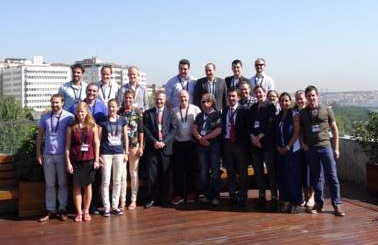
The participants of the 2013 PhD Seminar
 

Call for proposals: ESMQ Special Issue 2016

ESMQ is requesting for proposals for the special issue 2016! The ESMQ board has set out the following guidelines for guest editors of forthcoming special issues.

Guest editors are invited to submit proposals for special issues. Proposals should explain the relevance of the topic, the purpose of the special issue, examples of themes and sub-themes, as well as names of potential contributors. These proposals are discussed and selected by the ESMQ board members. The DEADLINE for submissions is NOVEMBER 1st 2013.

Guest editors are expected to organize a special workshop during the following EASM conference (2014 in Coventry). This workshop will allow to collect a substantial number of potential manuscripts on the topic, which can then be included the in the special issue to appear the following year (deadline for print November 2015). Publication will then be the first issue of ESMQ in 2016.

Guest editors must coordinate the double blind review process for each submitted article to the special issue (from January – October 2015). The quality of the reviewing process is of highest importance therefore, guest reviewers are required to indicate a pool of potential reviewers for the special issue.

In summary, this is a two year process:
1. Submit special issue proposal until 1. November 2013 (esmq@uni-mainz.de<mailto:esmq@uni-mainz.de>)
2. Special issue topic is assigned during the EASM conference 2014
3. The guest editor(s) is (are) required to organize workshop on the topic in Coventry 2014.
4. Following the workshop, materials for the special issues can be submitted.
5. The double blind review process takes place with a panel of highly qualified reviewers (in 2015).
5. Special issue to be appear in the first issue 2016 – however iFirst (online) publication can happen already in 2015.

We are looking forward to receiving your suggestions and proposals.
Please send to: Holger Preuss, Editor ESMQ (esmq@uni-mainz.de)

Yours Holger Preuss
Editor

Call for Sub-theme Workshops, 22nd EASM Conference, Coventry 2014

EASM invites sport management scholars to organise workshops on sub-themes of sport management at the 22nd EASM Conference held in Coventry, UK, from 9 to 12 September 2014. Workshops aim to encourage a profound discussion and close cooperation between participants on a particular subtheme (i.e. a specific focus within a more general topic). If successful, workshops can channel their work into special issues in ESMQ or other journals or edited books. Members interested in organising a workshop should submit the following information by email to both the Chair of the Scientific Committee ( bo.carlsson@mah.se) and the Vice-chair Veerle De Bosscher (vdebossc@vub.ac.be ) quoting Workshop Proposal in the subject line:

1. The sub-theme and title of the Workshop.

2. A short description of the proposed Workshop (maximum 500 words), to include four key words that capture its essence. Remember that the title and description should be used to arouse interest in the workshop when announced in the Call for Abstracts. Please refer to the history of the Workshop if it has already been staged in previous EASM conferences

3. The argument and expected demand for papers to the Workshop

4. The expected format of the Workshop (such as small symposium, panels, presentation of small or full papers, numbers of papers expected etc.)

5. The names, institutions, email addresses, phone numbers and research fields of all the conveners (should be minimum 2 – maximum 4 conveners, representing more than one country)

6. The name of the lead convener. This person will be responsible for the review and final acceptance of the papers in the Workshop, the coordination of conveners, and for communication with the scientific committee of the Conference as well as with colleagues at EASM involved in organizing the Conference

7. A short description of the lead convener’s previous experiences of organizing conference Workshops or other relevant information on the lead convener’s organization capabilities

8. A brief biography of each convener, and in the case of scientific workshops the convener’s most relevant international publications should be cited.

The deadline for submission of a Workshop proposal is November 1, 2013.

The workshops can have different forms within the limits of the conference program and depending on the ideas of the conveners which are responsible for putting together the workshop program, but as a general rule the Conveners’ guidelines found below should be adhered to.

Guidelines for EASM Sub-theme Workshop conveners

a) Before applying to set up a workshop, conveners should take care that the sub-theme will capture abstracts of a subset of broader topics rather than inviting abstracts that

will more naturally fall within a broader topical session (such as sport policy, sport marketing, sport leadership, sport governance etc.)

b) To keep focus on the suggested sub-theme conveners are advised to plan for a rather small number of presentations and sessions. Unless the demand is very high the format should not extend 2-3 sessions or 6-10 papers/presentations.

c) The conveners should prepare an introduction to the workshop, stating the current state of research in the field and the ambitions of the workshop.

d) At the end the conveners should spend time to rounding up the workshop, summarizing its contribution to the field and if possible, initiate publishing the best papers

e) The conveners should prepare a brief written report of the contribution of the workshop to be published on the EASM website

f) The conveners are encouraged to keep a contact list of the delegates attending their workshop

The EASM New Researchers Award

An important part of the annual EASM conference is the New Researchers Award (NRA). Organized by ESMQ & Sponsored by Routledge Journals, the NRA is for the best original theoretical or conceptual advance and significant unpublished contribution in sport management. The research should be appropriate for presentation at the Annual EASM conference and for publication in the European Sport Management Quarterly. To be eligible for this award, researchers must be near to completion of their PhD or have graduated less than three years prior to submission. The prize is established to stimulate dissemination of new ideas and innovative research in Sport Management by encouraging new researchers at the start of their career.

For this award a three stages process is used:

Round 1: Applicants submit a 5-page word abstract (single-spaced format) to the EASM 2013 conference organizers (using the on-line abstract form) by DATE 3, indicating they want to participate in the NRA. All abstracts will be blind reviewed by the NRA Jury, and selected candidates will be invited to participate in round 2. Deselected abstracts are either rejected (for poor quality) or, if accepted, transferred to the regular scientific program, i.e. to the topical sessions or a workshop.

Round 2: Successful candidates submit a full paper in MS-Word (*.doc) format by DATE 4, to the coordinator of the NRA (Papadimitriou Dimitra (dpapad@upatras.gr). All papers will be reviewed, and selected candidates will be invited to the next phase. Deselected papers are transferred to the regular scientific program, i.e. to the topical sessions or a workshop.

Round 3: Nominees from round two are invited to present their papers at the 2013 EASM conference.

The language for each submission is English.

Successful candidates need to provide a statement regarding the stage of their academic career, including when appropriate the date of graduation for their doctoral degree.The research paper may not have been presented or published previously in scholarly outlets.

If the paper constitutes part of a broader research project undertaken by the student and/or advisor, a note as to how the submitted paper represents an original, independent contribution must be provided by the student’s advisor/supervisor.

The author/s of the best paper will receive a prize of €600 which has been donated by Routledge Journals. In addition, the winner will receive a complimentary one-year EASM membership, which includes a free annual subscription to the ESMQ. The winner will also be invited to submit a full paper of his/her work to the ESMQ for publication, taking into account the comments and feedback of the reviewers on how the paper may be strengthened for possible publication.

An expert panel will adjudicate on the award, which will be weighted as follows:

70% will be based on the written paper
30% will be based on the oral presentation during the EASM conference

Abstract requirements for the EASM New Researchers Award (NRA) are detailed in the Format section of the 2013 conference.

Call for Papers: ESMQ 2014 Special Issue “Value Co-Creation in Sport Management”

The aim of this ESMQ Special Issue is to spark the debate over value co-creation in the context of sport management, to develop better theories, and to provide guidelines for sport managers for the design of value creation as a collaborative relational and dynamic process between multiple actors. Guest editors for this issue will be Herbert Woratschek, Chris Horbel, and Bastian Popp (University of Bayreuth, Germany).

Please click here for the complete elaboration on the subject and call for papers.


Welcome are submissions which address topics that cover any of the following subjects, but are not (necessarily) limited to:


  • Conceptualization of Value Co-Creation in Sport Management
  • Relationships and Relationship Marketing
  • Resource Integration in Sport Management
  • Cultures of Consumption and Brand Communities in Sport Management
  • Co-Branding in Sport Management
  • Fan Behaviour
  • Cooperation and Competition in Sport Management
  • Alliances and Networks in Sport Management
  • Service Dominant Logic and Sport Management

Special Issue Timelines

  • April 15th 2013 – the strict deadline for submissions of manuscripts to the ESMQ ScholarOne Manuscripts site: http://mc.manuscriptcentral.com/resm. Please indicate that the manuscript is a candidate for the special issue “Value Co-Creation in Sport Management”.
  • June 15th 2013 – return reviewers’ comments to authors
  • August 15th 2013 – deadline for authors’ response to reviewers and to submit revised manuscript, and if necessary followed by a second round of review and final editing
  • November 1st 2013 – editors’ submission of accepted manuscripts to the publisher
  • February 2014 – publication of special issue as European Sport Management Quarterly (14,1)

Contact
If you have questions on the ESMQ Special Issue please contact the guest editors and send an email to esmq@uni-bayreuth.de. We also encourage you to keep informed about the topic and join the debate in our facebook community and follow us on twitter.

Call for Sub-theme Workshops, 21th EASM Conference, Istanbul 2013

PLEASE NOTE THAT THE DEADLINE FOR SUBMISSIONS IS POSTPONED TO 29 OCTOBER, 2012

EASM invites members to organise workshops on sub-themes of sport management at the 21th EASM Conference held in Istanbul, Turkey, 2013. Workshops aim to encourage a profound discussion and close cooperation between participants on a particular subtheme (which is a specific focus within a more general topic). If successful, workshops can channel their work into special issues in ESMQ or other journals or edited books.


Members interested in organising a workshop should submit the following information by email to both the Chair of the Scientific Committee (hallgeir.gammelsater@himolde.no ) and the Vice-chair Veerle De Bosscher (vdebossc@vub.ac.be) quoting Workshop Proposal in the subject line:
1. The sub-theme and title of the Workshop.
2. A short description of the proposed Workshop (maximum 500 words), to include four key words that capture its essence. Remember that the title and description should be used to arouse interest in the workshop when announced in the Call for Abstracts. Please refer to the history of the Workshop if it has already been staged in previous EASM conferences

3. The argument and expected demand for papers to the Workshop
4. The expected format of the Workshop (such as small symposium, panels, presentation of small or full papers, numbers of papers expected etc.)
5. The names, institutions, email addresses, phone numbers and research fields of all the conveners (should be minimum 2 – maximum 4, and representing more than one country)
6. The name of the lead convener. This person will be responsible for the review and final acceptance of the papers in the Workshop, the coordination of conveners, and for communication with the scientific committee of the Conference as well as with colleagues at EASM involved in organizing the Conference
7. A short description of the lead convener’s previous experiences of organizing conference Workshops or other relevant information on the lead convener’s organization capabilities
8. A brief biography of each convener, and in the case of scientific workshops the convener’s most relevant international publications should be cited.
9. The deadline for submission of a Workshop proposal is October 29, 2012.
The workshops can have different forms within the limits of the conference program and depending on the ideas of the conveners which are responsible for putting together the workshop program, but as a general rule the Conveners guidelines found below should be adhered to.
Guidelines for EASM Sub-theme Workshop conveners

a) Before applying to set up a workshop, conveners should take care that the sub-theme will capture abstracts of a subset of broader topics rather than inviting abstracts that will more naturally fall within a broader topical session (such as sport policy, sport marketing, sport leadership, sport governance etc.)
b) To keep focus on the suggested sub-theme conveners are advised to plan for a rather small number of presentations and sessions. Unless the demand is very high the format should not extend 2-3 sessions or 6-10 papers/presentations.
c) The conveners should prepare an introduction to the workshop, stating the current state of research in the field and the ambitions of the workshop.
d) At the end of the workshop the conveners should undertake a conclusion of the workshop, summarizing its contribution to the field
e) The conveners should prepare a brief written report of the contribution of the workshop to be published on the EASM website
f) The conveners are encouraged to keep a contact list of the delegates attending their workshop