
Author: jacky
Read ESMQ issue 16(4) online now!
ESMQ Issue 16(4) brings together an array of research papers that cover topics that comment on and delve into the Workplace, Sport Teams, Community Legacy, Football’s regulatory environment and CSR, and Sport Fan Tourists. The perspectives offered from Europe and further afield provide us with insights that are not only contextual, but have broader applicability for sport management scholarship and practice.
| Research article
Passion in the workplace: empirical insights from team sport organisations Christos Anagnostopoulos, Mathieu Winand & Dimitra Papadimitriou |
| Research article
Exploring the impact of country-of-origin fit and team identification in sports brand evaluation |
| Research article |
| Research article
Panagiotis Dimitropoulos, Stergios Leventis & Emmanouil Dedoulis |
| Research article
Analysing the motivations of Japanese international sports-fan tourists Tatsuru Nishio, Roy Larke, Harald van Heerde & Valentyna Melnyk |
| Research article |
| Research article |

EASM 2016 in Warsaw was a great success
The annual EASM conference in September 2016 organized by Vistula University and Professor, Rector Jolanta Zysko was a great success. Participants get to enjoy a well-organized conference, Polish hospitality and delicious dishes during the warm conference days. The beautiful city of Warsaw surely fascinated everyone taking part in the event. The Gala dinner at magnificent PGE stadium, social networking events in Vistula University and Olympic center, together with pleasant atmosphere, is something all the participants will remember.
Thank you Jolanta and you team for a wonderful week in Poland!
EASM Board


EASM 2016: Extended submission deadline
Dear colleagues,
We are thrilled about the number and the quality of the proposals we see coming in for the EASM 2016 Conference on Sport Management at Warsaw. Although the number of submissions to the topical tracks, to the workshops and to the New Researchers Award is significant already, many colleagues requested a deadline extension to be able to submit their work. We are happy to follow this suggestion and extend the deadline for all abstracts to April 15th, 2016.
http://easm2016.com/call-for-papers/
http://easm2016.com/the-easm-new-researchers-award-nra-2016
Don’t miss this year’s EASM: Prof. Jolanta Żyśko and her amazing team have put together an exiting program with a very strong scientific program, excellent keynote speakers, thought-provoking seminars for students and PhDs, and most memorable events and receptions.
Welcome to the vibrant city of Warsaw! We are looking forward to receiving your best of work as abstracts. Save the date: All abstracts must be submitted by April 15, 2016.
The EASM 2016 LOC & The EASM Scientific Committee & The ESMQ Editorial Board
Abstracts for the upcoming EASM Conference 2016 can be submitted via the following link:
www.abstractreviewer.com/easm
The deadline for submission is April 15, 2016. Submit yours today!
More information on the EASM Conference 2016 and the call for abstracts can be found at:
http://easm2016.com/call-for-papers/
EASM 2016: Abstract submission information
Abstracts for the upcoming EASM Conference 2016 can be submitted via de following link: www.abstractreviewer.com/easm
The deadline for submission is 1 April 2016.
Submit yours today!
More information on the EASM Conference 2016 and the call for abstracts can be found at http://easm2016.com/call-for-papers/

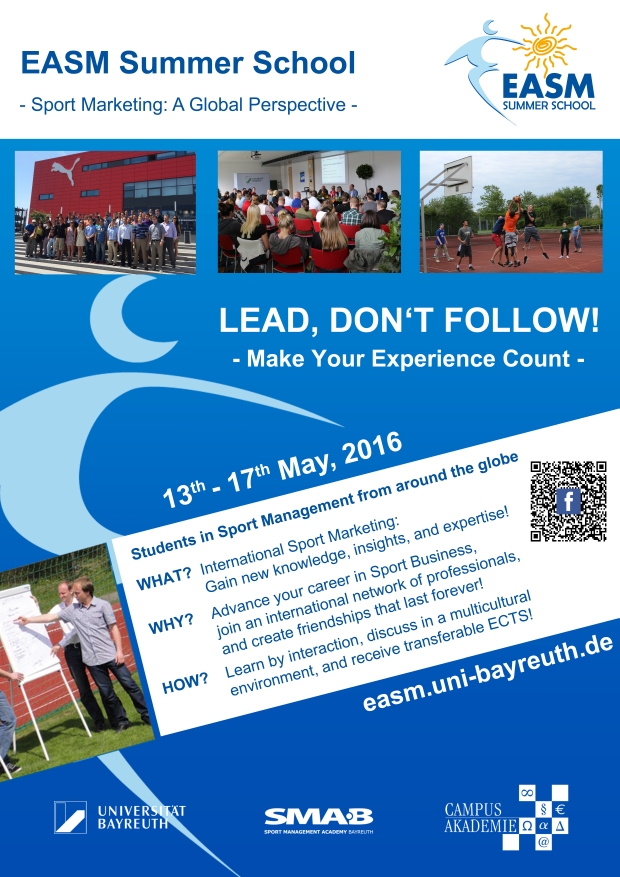
7th EASM Summer School 2016
LEAD, DON’T FOLLOW!
Make your own experiences during 7th EASM Summer School 2016 at the University of Bayreuth, Germany!
In the tradition of its international student seminars and three EASM Summer Schools, the EASM Board and the University of Bayreuth continue its cooperation with the 7th EASM Summer School (13th – 17th May 2016) in order to offer a strong and differentiated service for future sport management professionals.
The EASM School is a great opportunity for Bachelor and Master students to enrich their degree with new insights in the field of International Sport Marketing. Participants have the chance to build up their own international network within the sport business and to make new friends from all over Europe.
Facts & Figures:
– Time: 13th – 17th May 2016.
– Place: Campus / Sport Institute of the University of Bayreuth, Germany.
– Content: Focus will be on International Sport Marketing. Knowledge in this field is essential to all sport managers of non-profit and for-profit sport organizations.
– Learning objectives: Getting new insights and expertise in the field of International Sport Marketing. Furthermore, students will be able to apply professional marketing tools in their sport organizations.
More information can be found here.
ESMQ: Call for Papers 2018 Special Issue (18.1)
CALL FOR PAPERS
ESMQ 2018 Special Issue (18.1)
Managing High Performance Sport
As nations become more strategic in the way they produce elite athletes, sport systems move beyond the mere application of sport sciences, facilities and coaching as a sole base for elite athlete success. There is compelling evidence to suggest that the ‘new’ point of difference and competitive advantage for nations is effective management and governance of high performance sport (HPS). HPS and its management is a rapidly expanding profession in many countries around the world, one that continues to grow in size and sophistication. Although the number of athletes represented at this level of performance is marginal compared to the overall population, the number of stakeholders involved with high performance sport (e.g., specialising coaches, team directors, performance managers, administrators, sport agencies, sport organizations, individuals and beneficiaries, sponsors and media, governments and government agencies at all levels, academics and researchers, facility managers, team owners, athlete agents, sports and other scientists) is increasingly expanding to an industry that is becoming largely compound. Although the field of sport management has been widely defined, this relatively newly emerged concept of managing HPS is in its infancy and its characteristics are far from clear. As the discipline of sport management matures, HPS management emerges as a swiftly developing branch of knowledge. However, shifts in industry practices (i.e., hiring high performance directors and placing an emphasis on HPS management practices) have not been matched with an equivalent focus of academic inquiry that would help define the field, distinguish it from other fields and illustrate its significance in empirical ways. As Sotiriadou and De Bosscher (2013) outline in the Funnel of Managing High Performance Sport Framework, the factors that contribute to international sporting success can be explored within (a) the broader environment and elite policies around HPS (i.e., macro), (b) HPS management at an organisational/sport policy level (i.e., meso) (c) managing high performance athletes and the processes that would attract, retain/transition and nurture athletes (i.e., micro), and (d) specific pressures from media, sponsors, society, coaches, peers and family in the fast changing and highly volatile environment that HPS operates in. All these levels interact and increasingly influence the management of HPS. This complex nature of HPS reiterates the need to clearly conceptualise the research field in order to contribute theoretically and empirically to the sport management literature.
Aim of Special Issue
HPS is an all-encompassing umbrella term that is inclusive of social, managerial, economic marketing and even legal aspects of managing sport at the highest levels. Up until the 1970s and 1980s, in most countries, the typical elite sport system used to operate in a simple fashion where talented or elite athletes would train with a coach under the supervision or direction of the sports federations. This is now replaced with an ever increasing crew of experts (the HP team of experts) that work around the athlete and interact closely. Collins et al. (2013) refers to this evolution in the system as ‘the team around the athlete’ and explains how members of this team come together to guide and manage athletes. The aim of this special issue is to build on the existing research on the management of HPS and increase our understanding of the complexity of managing high performance within the context of sport. Furthermore, the issue aims to encourage submissions and critical analysis on existing research and broad-global theoretical approaches on ways elite sport is managed in sport systems/countries not as developed in their planning and processes as for example in Europe and Australia. The special issue welcomes submissions from a wide spectrum of elite sport and sport development including non-Olympic sports, professional style elite sport and team sports (e.g., baseball, American rugby), and
emerging sports that follow a different trajectory (e.g., peer coaching, self-testing, high levels of aesthetic focus over competitive outcomes).
Accordingly, the purposes of the special issue are: 1) to examine the current gaps in the management of HPS research worldwide; 2) to encourage new approaches that contribute to the conceptualisation of HPS; 3) to facilitate critical analysis on the management of elite sport in sport systems or countries not as developed in their planning and processes; 4) to examine a wide spectrum of sports and elite development processes; and 5) to set a research and management agenda for future development.
Examples of themes/sub-themes
Contributors may come from any social or human science discipline; qualitative, quantitative and mixed method research approaches that would focus on the multidimensionality of the management of HPS are welcome. Specifically, we invite contributors to examine empirically and theoretically the following themes and subthemes:
• Governance, organisation and management of HPS in Olympic, non-Olympic, extreme or professional sports/teams
a. Centralisation and decentralisation of HPS and talent management
b. Managing elite athlete entourage
c. The public and private sector involvement with managing HPS
d. Managing the high performance team, coaches and athlete entourage
e. Emerging trends in organising HPS systems and policies
f. Developing HPS in countries with less developed sport systems
g. The roles of different stakeholders in managing HPS sport (e.g., coaches roles, HO directors, parents, sport development officers, volunteers, significant others)
h. The roles of different sport organizations in managing HPOS (e.g., IOC, IFs, Olympic Committees, NSOs, clubs, academies, governments, government agencies, WADA, sport and recreation departments)
i. Managing high performance organisations
j. Managing teams in high performance
• Marketing and technologies in HPS
a. Managing elite athlete brand identity and image and sponsorships/endorsements
b. The ways new technologies influence the management of HPS
• Social issues in the management of HPS
a. Gender issues in the management of HPS (e.g., athlete and coaches equity and equality, country specific environments)
b. Ethics in managing HP sport
• Economic, legal and commercial aspects of managing HPS:
a. The commercialisation and professionalisation of HPS and of elite athletes and HPS in general
b. Resourcing, investing and offering value for money in HPS
c. Legal aspects on athlete contracts, transfers or exchanges
Call for the ESMQ 2018 Special issue (18.1)
Papers should be submitted in electronic format through Manuscript Central using the following link: http://mc.manuscriptcentral.com/resm; indicating you want the manuscript to be considered for Special Issue 18.1 [manuscripts in review process].
Proposed and Indicative Timeline:
March 20, 2016: Invitation to participate in the Special Issue Workshop @ the 24rd EASM 2016 Conference (Warsaw, Poland, 7-10 September 2016). This is an optional activity.
November 30, 2016: Submission deadline of full papers for consideration for the 2018 ESMQ Special Issue. Manuscripts in review process.
January 31, 2017: Feedback to authors
March 31, 2017: Return date for revised manuscripts
Second round of review process (if necessary)
May 31, 2017: Second revisions back from authors
Final decisions are made
Materials are prepared for final publication
July 15, 2017: Materials sent to Publisher
From this date onwards, the materials will be available for readers on iFirst
January 2018 publication of European Sport Management Quarterly, 18(1)
Guest editors
Dr. Popi Sotiriadou, Griffith University, Gold Coast, p.sotiriadou@griffith.edu.au
Dr. Veerle De Bosscher, Vrije Universiteit Brussel, vdebossc@vub.ac.be
Call for Sub-theme Workshops, 24th EASM Conference, Warsaw 2016
Call for Sub-theme Workshops, 24th EASM Conference,
Warsaw, September 7-10, 2016
EASM invites sport management scholars to organise Workshops on various sub-themes of sport management at the 24th EASM Conference in 2016 (www.easm2016.com). The conference theme will be “Memories and identities in sport management in Europe”. In that respect, EASM encourages particularly, but not solely, Workshops proposals that connect to that theme.
Generally, Workshops aim to encourage a profound discussion and close cooperation between participants on a particular subtheme (i.e. a specific focus within a more general topic). Workshops could also be instrumental, e.g. to channel work into special issues in ESMQ or other journals or edited books; to integrate theory and practice; and to map out new sport management research territory.
Members interested in organising a Workshop should submit the following information by email to the members of the Scientific Committee (Bosse Carlsson, Chair, bo.carlsson@mah.se), Christian Germelmann (c.c.germelmann@uni-bayreuth.de) and Tim Breitbarth (tbreitbarth@bournemouth.ac.uk) quoting Workshop Proposal in the subject line:
- The sub-theme and title of the Workshop;
- A short description of the proposed Workshop (maximum 500 words), to include four key words that capture its essence. Remember that the title and description should be used to arouse interest in the workshop when announced in the Call for Abstracts. Please refer to the history of the Workshop if it has already been staged in previous EASM conferences;
- The argument and expected demand for papers to the Workshop;
- The expected format of the Workshop (such as small symposium, panels, presentation of small or full papers, numbers of papers expected etc.);
- The names, institutions, email addresses, phone numbers and research fields of all the conveners (should be minimum 2 – maximum 4 conveners, representing more than one country);
- The name of the lead convener. This person will be responsible for the review and final acceptance of the papers in the Workshop, the coordination of conveners, and for communication with the Scientific Committee of the conference as well as with colleagues at EASM involved in organizing the conference;
- A short description of the lead convener’s previous experiences of organizing conference Workshops or other relevant information on the lead convener’s organization capabilities;
- A brief biography of each convener, and in the case of scientific workshops the convener’s most relevant international publications should be cited.
The deadline for submission of a Workshop proposal is November 22, 2015.
The Workshops can have different forms within the limits of the conference program and depending on the ideas of the conveners which are responsible for putting together the workshop program, but as a general rule the Conveners’ Guidelines found below should be adhered to.
Guidelines for EASM Sub-theme Workshop Conveners
- Before applying to set up a Workshop, conveners should take care that the sub-theme will capture abstracts of a subset of broader topics rather than inviting abstracts that will more naturally fall within a broader topical session (such as sport policy, sport marketing, sport leadership, sport governance etc.). The evaluation of the proposal will be based on the broad appeal of the topic to the EASM community; the contribution to the field of sport management, and the questions raised in the workshop and their potential for discussion;
- To keep focus on the suggested sub-theme conveners are advised to plan for a rather small number of presentations and sessions. Unless the demand is very high the format should not extend 2-3 sessions or 6-10 papers/presentations;
- It is at the conveners’ discretion to encourage or demand extended abstracts or full papers in order to increase quality and ‘substance’ of the Workshop;
- The conveners should prepare an introduction to the Workshop, stating the current state of research in the field and the ambitions of the Workshop;
- The conveners’ could invite a very small number of industry guest presenters (on their own expenses and after discussion with the Scientific Committee) in order to facilitate theory-practice integration shall this be of benefit to the Workshop outcome and participants’ conference experience;
- At the end the conveners should spend time to rounding up the Workshop, summarizing its contribution to the field and if possible, initiate publishing the best papers;
- The conveners should prepare a brief written report of the contribution of the Workshop to be published on the EASM website;
The conveners are encouraged to keep a contact list of the delegates attending their workshop.
To download this call in PDF format click here.
EASM2015: New Researchers Award
An important part of the annual EASM conference is the New Researchers Award (NRA). Organized by ESMQ and sponsored by Routledge Journals, the NRA is for the best original theoretical or conceptual advance and significant unpublished contribution in sport management. The research should be appropriate for presentation at the annual EASM conference and for publication in the European Sport Management Quarterly. To be eligible for this award, researchers must be near to completion of their PhD or have graduated less than three years prior to submission. The prize is established to stimulate dissemination of new ideas and innovative research in Sport Management by encouraging new researchers at the start of their career. More information on the NRA can be found here.
At the EASM 2015 Conference held in Dublin, Ireland, the NRA was awarded at the closing banquet on September 12th, 2015.
Winner:
Felix Wemmer: Performance Impact of Coopetition-based Open Innovation in Nonprofit Sports Clubs
Runner-ups:
Joon Sung Lee: Different Consumer Responses to Athlete Transgression: Comparison between Individualistic and Collectivistic Culture
Wojtek Kulczycki: Why Sponsors Should Worry about Corruption as a Mega Sport Event Syndrome
The winner will receive €500 as first prize. Both runner-ups can choose a Routledge book to the value of £100.

New most prestigious EASM award: EASM Chelladurai Award.
EASM names it’s most prestigious award after professor Packianathan Chelladurai, Troy University.
At the 23rd annual conference of European Association for Sport Management, EASM, Professor Packianathan Chelladurai of Troy University was rewarded the new most prestigious EASM award – EASM Chelladurai Award.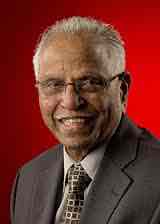
The award is of course named after Professor Chelladurai himself and can, according to the statues by decision of the EASM board, be given to a recipient who meets the following qualifications:
• Must be an EASM member that has not previously received the Award.
• Must during a minimum of ten years been serving as a teacher, supervisor, administrator, or combination of the above.
• Must have made significant contributions to the field of sport management through scholarship, research, and leadership and must have be known for peer recognition of his/her contributions.
• Must have made a significant contribution to the field of sport management within EASM.
• Must in his/her work and deeds demonstrate those qualities proved by Professor Chelladurai in the areas of student growth and development, leadership, service, scholarship, and collegiality.
Professor Chelladurai received the prize from the President of EASM PG Fahlström during a special Award Cermony Thursday September 10th.